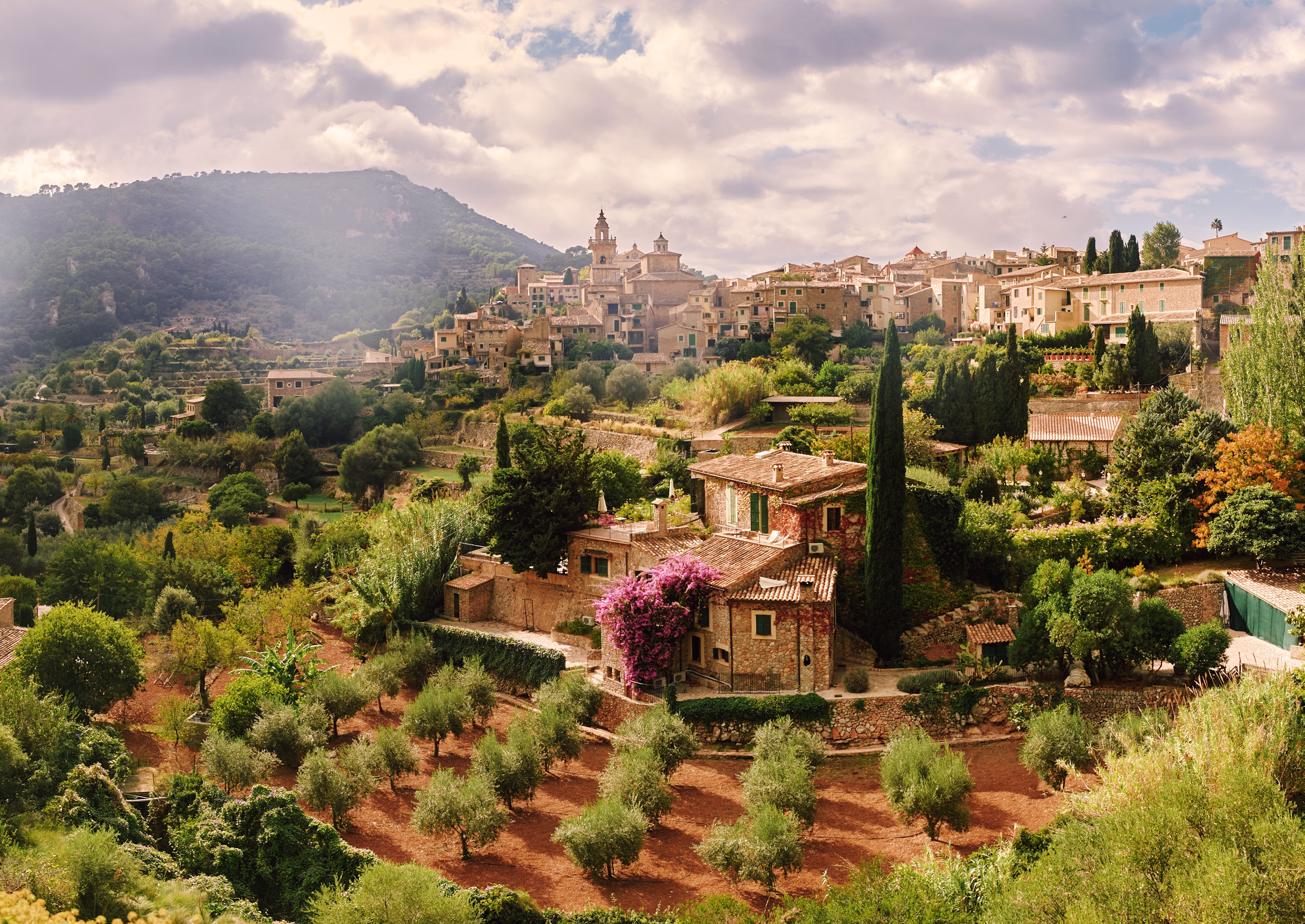
Valldemossa
A village of light, stone and quiet legend.
High in the folds of the Serra de Tramuntana, the quiet stone village of Valldemossa holds a particular place in the European imagination. A history of royal patronage and artistic pilgrimage has guarded its character, leaving it remarkably untouched by the tides of time.
A storied village
The story of Valldemossa is anchored by its Royal Charterhouse, founded as a palace for King Martín I in the 14th century before being ceded to Carthusian monks. Its august silhouette still defines the skyline, a testament to centuries of contemplation and seclusion.
Within these walls, in cell number four, Frédéric Chopin and George Sand endured a famously difficult winter in 1838. From that cold and damp came transcendent art: Chopin’s Preludes, Op. 28, and Sand’s seminal travelogue, *Un hiver à Majorque*, which etched the village’s raw beauty into literary history.
But the village’s spirit extends far beyond the monastery gates. A deeper, more local reverence is felt for Santa Catalina Thomàs, the island’s patron saint, born here in 1531. Small blue-and-white ceramic tiles,*rajoletes*,adorn the thresholds of many homes in her honour. Following the cobbled gradients of lanes like carrer Reial, one finds life unfolding at a gentle pace. The scent of *coca de patata*, a soft local pastry, drifts from family bakeries, and doors open into small ateliers and quiet cafés where conversations linger.
This is a place of substance, not a mere stage set for visitors. The morning market fills the air with sound, neighbours greet each other by name, and the life of the village moves with the steady, quiet rhythm of the seasons.
A protected landscape
The village is inseparable from its setting within the Serra de Tramuntana. In 2011, this entire mountain range was named a UNESCO World Heritage site, not for its wildness alone, but as a cultural landscape,a place profoundly shaped by a millennium of human effort in concert with nature. Ancient olive groves and almond trees cling to slopes sculpted by generations of labour.
This patient work is most visible in the endless kilometres of dry-stone walls, or *pedra en sec*, that terrace the mountainsides. These structures are the architecture of the landscape, channelling water, preventing erosion, and creating the very ground upon which life is cultivated. Following their lines reveals hidden torrents, shaded holm oak forests, and sudden, breathtaking viewpoints, or *miradors*, that open onto the sea.
Valldemossa benefits from the mountains' distinct micro-climate, its air cooler and fresher than that of the plains below. Dawn often arrives with a fine mist rising from the valleys, carrying the scent of wild rosemary and pine. This is a landscape to be moved through. The celebrated GR-221 long-distance trail, the ‘Ruta de Pedra en Sec’, passes nearby, while a short drive reveals the rugged coastline and its intimate coves, the *calas*, where the mountains meet the Mediterranean.
To inhabit this landscape is a rare privilege. The protections that preserve the integrity of the Tramuntana mean that permission for new construction is exceptionally scarce. The four villas of this collection exist because of this considered approach,a quiet, singular addition to a land where very little is now added.
Distances